Monthly Archives: October 2017

Office 365: Messages from external senders are originating directly on Office 365 servers….

Today I had an interesting case come across my desk.  A customer wanted to enforce that all external messages came through their third party cloud gateway.  In an effort to prevent bypassing the gateway and having mail traffic come directly into Office 365 the customer wanted to craft a transport rule to catch and quarantine these messages.  The rule was created as follows:


Execute the rule on any sender that is external to the organization.  Perform the action quarantine on the message.  (In this instance though the rule just audited because the customer was testing – an awesome idea by the way).  The rule should fire except when the submitting IP address is a dedicated IP address provided by the third party cloud gateway.


In most of all instances the rule looked like it was firing perfectly.  Messages that were submitted directly to Office 365 bypassing the primary MX record were captured when an external sender was involved.  When reviewing some messages that were captured by the rule the customer noticed something odd – a handful of the messages were sourced from and delivered to Office 365 servers.  There were no external servers involved in the transmission.  How did an external sender manage to submit messages sourced on Office 365 servers and destined to Office 365 servers.  Let’s take a look.


The first thing we did was gather a sample message header from Outlook.  Using http://www.testexchangeconnectivity.com and the message header analyzer we had the message header parsed.  The first thing we looked at were the transmission hops. 

Hop↓
Submitting host
Receiving host
Time
Delay
Type⇒

1
CY4PR0501MB3908.namprd05.prod.outlook.com ([::1])
CY4PR0501MB3908.namprd05.prod.outlook.com ([fe80::70ad:f6a:5ede:2b92%13])
‎10‎/‎13‎/‎2017‎ ‎4‎:‎27‎:‎46‎ ‎PM

Microsoft SMTP Server

2
CY4PR0501MB3908.namprd05.prod.outlook.com (52.132.100.162)
DM5PR05MB2938.namprd05.prod.outlook.com (10.168.176.138)
‎10‎/‎13‎/‎2017‎ ‎4‎:‎27‎:‎46‎ ‎PM

0 seconds

Microsoft SMTP Server (version=TLS1_2, cipher=TLS_ECDHE_RSA_WITH_AES_256_CBC_SHA384_P256)

3
DM5PR05MB2938.namprd05.prod.outlook.com (10.168.176.138)
BY1PR0501MB1223.namprd05.prod.outlook.com (10.160.104.150)
‎10‎/‎13‎/‎2017‎ ‎4‎:‎27‎:‎47‎ ‎PM

1 second

Microsoft SMTP Server (version=TLS1_2, cipher=TLS_ECDHE_RSA_WITH_AES_256_CBC_SHA384_P256)

4
BY1PR0501MB1223.namprd05.prod.outlook.com (10.160.104.150)
BN3PR0501MB1220.namprd05.prod.outlook.com (10.160.113.28)
‎10‎/‎13‎/‎2017‎ ‎4‎:‎27‎:‎47‎ ‎PM

0 seconds

Microsoft SMTP Server (version=TLS1_2, cipher=TLS_ECDHE_RSA_WITH_AES_256_CBC_SHA384_P256)


In this instance the situation was exactly as the customer described.  The first hop was an Office 365 server and the last hop was an Office 365 server.  The rule had fired on a message that did not originate through an external mail system.


The next header entry reviewed were the recipients.  The from header shows externaluser@externaldomain.com and the recipient is internalUser@office365domain.com.  This validated that the sender was external matching the transport rule apply to for messages originating from senders external to the organization.


So far the conditions for the rule to fire seem to be accurate –> the sender is validated as external, the message did not come from a third party gateway IP address, therefore action should be taken.  We still don’t know why though – why did a message that is seemingly completely external originate from an Office 365 server?


As we move through the header investigation we see additional entries that leads us to a conclusion that not everything is as it appears.  There were custom X headers that were added by the third party gateway.  If the message had originated directly on Office 365 why would there be custome headers stamped by the third party gateway?  This would seemingly indicate that the message passed through this third party gateway where actions were performed.  For example X-ThirdParty-Virus-Version and X-ThirdParty-Spam-Details were present in the header. 


Continuing to move through the header we note the presence of X-MS-Exchange-Parent-Message-ID.  This message id has the following value < numberString@google.com >.  This reinforces that the message was generated externally – it has an encapsulated original message ID from a remote mail system.  The message ID of this message is < fa80351799674b019521923f47ee0125@CY4PR0501MB3908.namprd05.prod.outlook.com >.  The message ID being an Office 365 message ID continues to reinforce that this message was generated within Office 365. 


Then we come to the following message headers that really crack this case wide open. 


X-MS-Exchange-Generated-Message-Source: Mailbox Rules Agent

X-MS-Exchange-Inbox-Rules-Loop:  recipient@office365domain.com


In this instance this message was actually generated within Office 365 and the message was actually from an external sender.  The reason it was generated is that the recipient listed in X-MS-Exchange-Inbox-Rules-Loop had an Outlook inbox redirect rule established.  The redirect rule creates a new message within Office 365, retains the original message headers including the from address, but changes the to recipient to the specified recipient.  We were able to track the forwarding rule down using this post – https://blogs.technet.microsoft.com/timmcmic/2015/04/19/office-365-determine-accounts-that-have-forwarding-enabled/.  When using this post and the recipient specified in the header the inbox rule containing the TO recipient was located and validated.  This confirms the message was redirected.


In this instance the rule did exactly what it was supposed to.  The sender was external, the recipient was internal, and the message did not originate from one of the IP addresses provided by the third party gateway. 
Office 365: DNS health checks and the Office 365 Portal

In recent weeks I have worked on several escalations regarding the DNS health checks in the Office 365 portal.  In August I published some guidance on how to review and handle these errors.  That article has since been updated to reflect new information and new portal behavior.  Please check out https://blogs.technet.microsoft.com/timmcmic/2017/08/15/dns-errors-and-warnings-in-the-office-365-portal/ for updated information.

Office 365: Who can receive the weekly digest email…

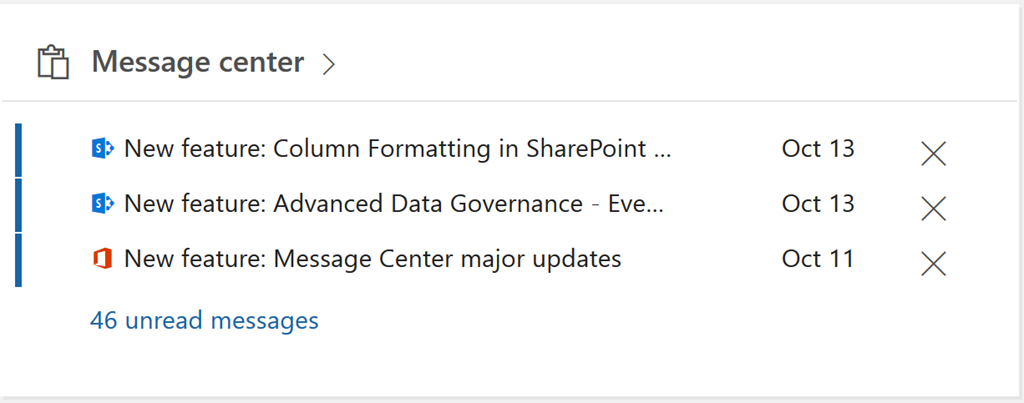
In Office 365 we provide administrators the ability to access important information about the service via the message center.  At https://portal.office.com on the main administration page the message center option appears in the center view.


image


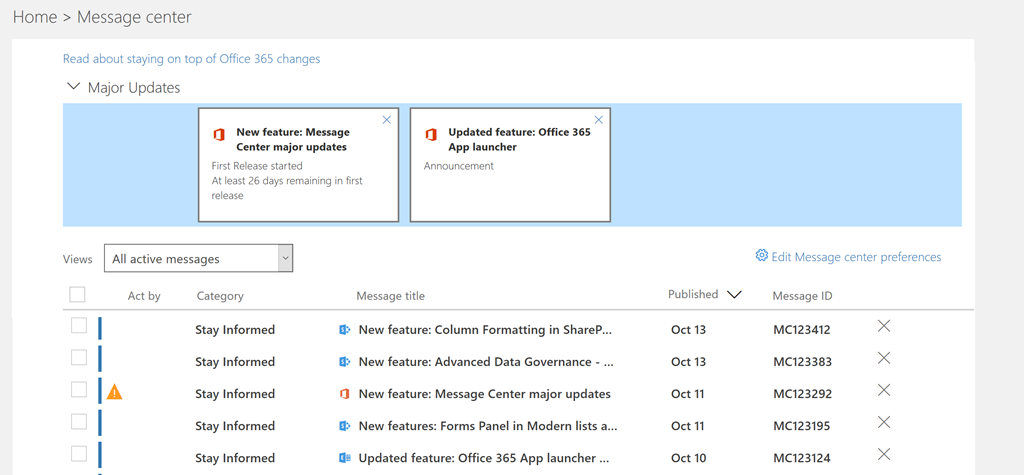
When selecting the message center option the administrator is presented with a list of notifications, announcements, and other messages regarding Office 365.


image


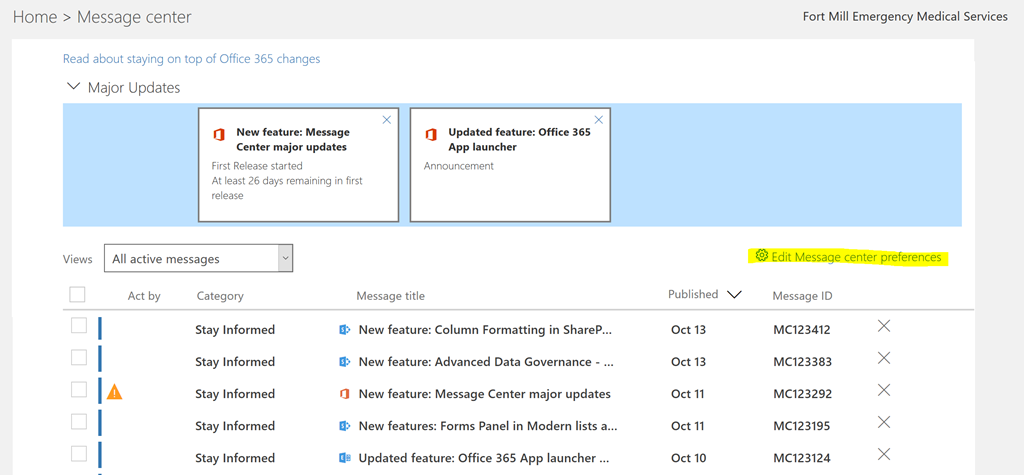
One of the options at the top right of the list is an option to edit message center preferences. 


image


image


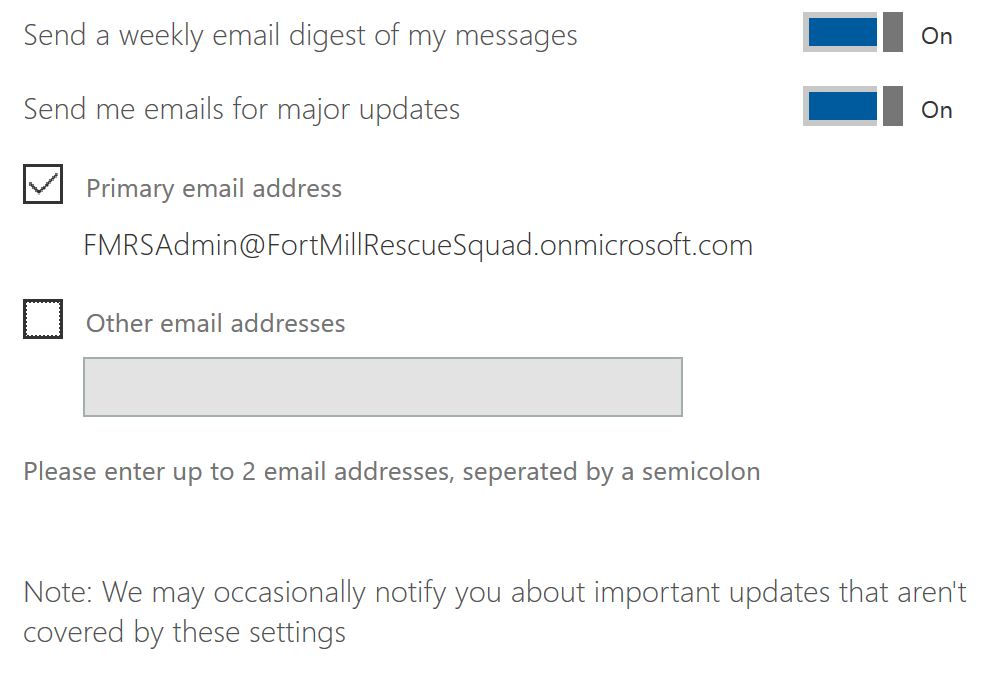
When editing message center preferences administrators can include or exclude difference services.  They can also signup for a weekly digest email to be sent using the email options at the bottom of the preferences selections. 


image


I recently had a customer inquire about how the weekly digest email could be provided to accounts that did not have administrator rights within Office 365.  For example – maybe you have a help desk group where receiving Office 365 notifications and announcements would be helpful but providing administrator rights in the Office 365 portal is not necessary.


One of the message center preferences allows the administrator to provide additional email addresses where the notifications can be sent.  The field allows for up to two email addresses to be specified.  My proposed solution to this was to specify a distribution list.  This would allow the administrator to add and remove members dynamically who they determined should receive these notifications without requiring any additional administrator access be provided within Office 365.  Let’s take a look at an example.


To being a distribution list was created – Office365Notification@contoso.com.  


PS C:> Get-DistributionGroup Office365notification@contoso.com

Name                  DisplayName           GroupType PrimarySmtpAddress
—-                  ———–           ——— ——————
Office365Notification Office365Notification Universal Office365Notification@contoso.com


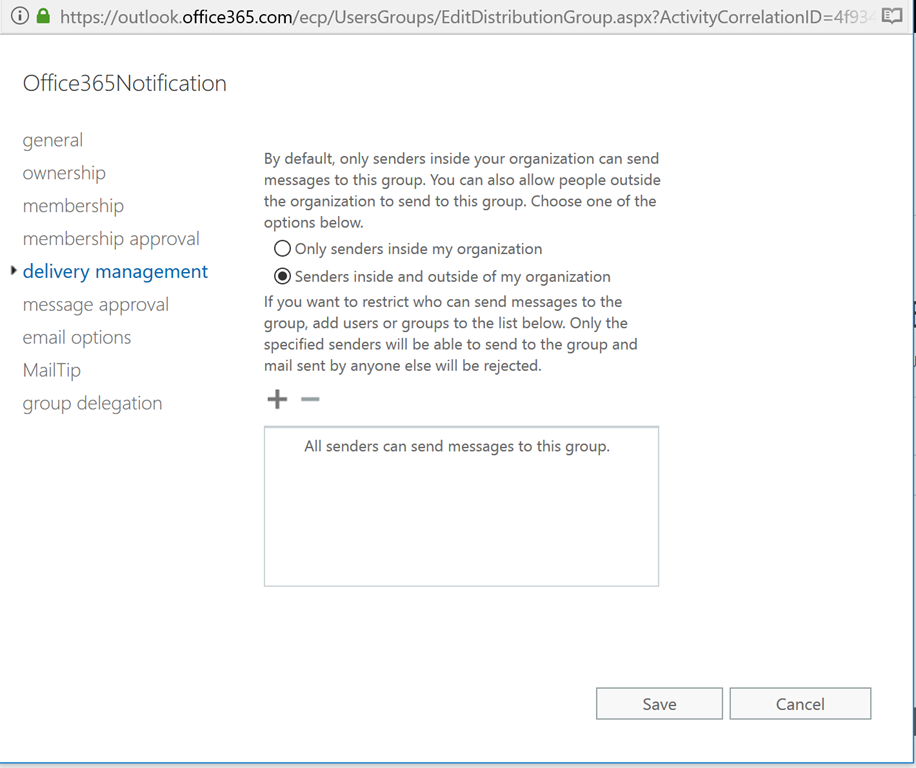
An important setting of the distribution list is to allow external emails to be delivered to the group.  The Office 365 Weekly Digest emails are technically external to the tenant and therefore this setting needs to be allowed in order for the group to receive messages.


Set-DistributionGroup Office365notification@contoso.com -RequireSenderAuthenticationEnabled:$FALSE


PS C:> Get-DistributionGroup office365notification@contoso.com | select-object name,requiresenderauthenticationenabled

Name                  RequireSenderAuthenticationEnabled
—-                  ———————————-
Office365Notification                              False


The ability to create this distribution group and adjust the settings is also available within the Office 365 Portal –> Exchange Administration Console. 


image


Once the group has been successfully created and the authentication settings modified you can add members to the group that you desire to receive notifications.  The members can be any recipient object within Exchange Online (including external mail enabled contacts etc). 


PS C:> Add-DistributionGroupMember -Identity Office365Notification@contoso.com -Member tmcmichael@cotoso.com


PS C:> Get-DistributionGroupMember -Identity Office365Notification@fortmillrescue.com

Name              RecipientType
—-              ————-
ContosoAdmin      UserMailbox
Timothy McMichael UserMailbox
Contact Mailbox   UserMailbox
Laurie Hays       UserMailbox


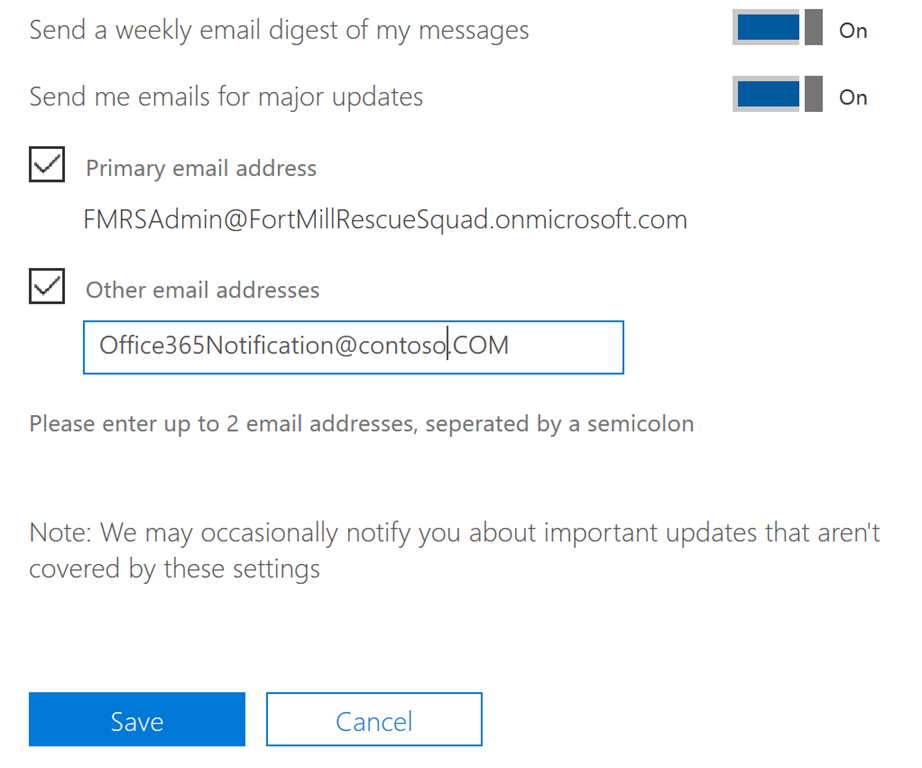
With the distribution group created, the security settings adjusted, and the members added you can now configure the notification settings for the group.  In this example I have taken a global administrator account and selected the message center preferences.  Under the weekly digest email settings I have selected the option for an additional recipient and specified the primary SMTP address of the notifications group that I created.


image


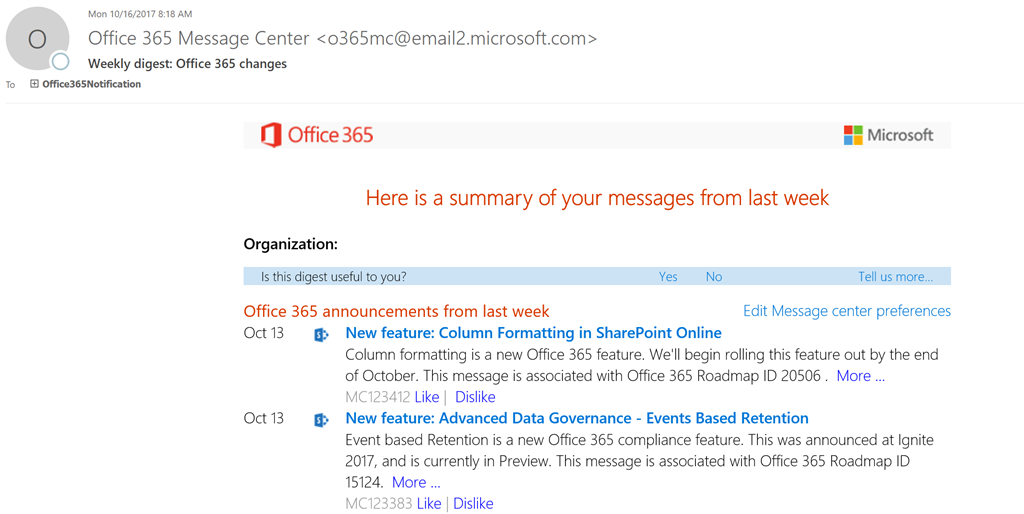
When this setting has been successfully applied members of the groups should start receiving the weekly digest email.  The weekly digest email will appear from an Office 365 service address to the primary SMTP address of the distribution list.  Here is an example of the email successfully sent to the distribution list and received by the member.


image


Using the distribution list method administrators and supply the weekly digest email to parties where it would be helpful to have the information but administration rights are not required.

Exchange, Cluster, and Network Thresholds

Cluster failures due to transient cluster communications problems can often lead to databases failing over between nodes or nodes being removed from cluster membership.  For many administrators the occasional network hiccups that can drive up the likely hood of this occurring is a fact of life.  It is definitely more prevalent when cluster nodes are geographically dispersed.


On occasion there are recommendations to change the cluster network thresholds that determine if a node is alive or failed.  A blog post that I’ve referenced for an explanation and guidance on this is published here:


https://blogs.msdn.microsoft.com/clustering/2012/11/21/tuning-failover-cluster-network-thresholds/


I’m not sure if I’ve missed it or if Elden recently updated it but I noticed that there are new values listed in the table for Windows 2016 based clusters.  I also noticed the following paragraph issuing what I thought was updated guidance on cluster network thresholds.


“To be more tolerant of transient failures it is recommended on Win2008 / Win2008 R2 / Win2012 / Win2012 R2 to increase the SameSubnetThreshold and CrossSubnetThreshold values to the higher Win2016 values.  Note:  If the Hyper-V role is installed on a Windows Server 2012 R2 Failover Cluster, the SameSubnetThreshold default will automatically be increased to 10 and the CrossSubnetThreshold default will automatically be increased to 20.  After installing the following hotfix the default heartbeat values will be increased on Windows Server 2012 R2 to the Windows Server 2016 values.”  This is a hotfix available that will do this for you.  https://support.microsoft.com/en-us/help/3153887/fine-tuning-failover-cluster-network-thresholds-in-windows-server-2012


If changing these values or considering changing them I encourage you to book mark Elden’s blog and reference it for guidance.

Office 365: Upgrading legacy distribution lists to Office 365 Groups

Office 365 groups are the recommended replacement for legacy distribution groups in Office 365.  You can learn more about Office 365 groups at the following link:  https://support.office.com/en-us/article/Learn-about-Office-365-Groups-b565caa1-5c40-40ef-9915-60fdb2d97fa2


In an effort to assist in the adoption of Office 365 groups we now offer administrators the opportunity to upgrade legacy groups to Office 365 groups.  The option exists both in the Exchange Control Panel, Outlook Web Access, and through Powershell.  There are certain perquisites that legacy groups must meet prior to being eligible for upgrade to Office 365 groups.  For information on methods to upgrade groups please review the following https://support.office.com/en-us/article/Upgrade-distribution-lists-to-Office-365-Groups-in-Outlook-787d7a75-e201-46f3-a242-f698162ff09f.  For information on pre-requisites for upgrading distribution lists reference the following https://support.office.com/en-us/article/Upgrade-distribution-lists-to-Office-365-Groups-in-Outlook-787d7a75-e201-46f3-a242-f698162ff09f#bkmk_which.


In this example we will review the upgrade process.  In my test tenant I have created 15,000 distribution groups.


PS C:> $groups=Get-DistributionGroup -ResultSize unlimited | where {$_.name -like “*TestDL*”}
PS C:> $groups.Count
15001


Name        DisplayName GroupType PrimarySmtpAddress                       
—-        ———– ——— ——————                       
TestDL      TestDL      Universal TestDL@contoso.onmicrosoft.com
TestDL0     TestDL0     Universal TestDL0@contoso.com               
TestDL1     TestDL1     Universal TestDL1@contoso.com               
TestDL10    TestDL10    Universal TestDL10@contoso.com              
TestDL100   TestDL100   Universal TestDL100@contoso.com             
TestDL1000  TestDL1000  Universal TestDL1000@contoso.com            
TestDL10000 TestDL10000 Universal TestDL10000@contoso.com           
TestDL10001 TestDL10001 Universal TestDL10001@contoso.com           
TestDL10002 TestDL10002 Universal TestDL10002@contoso.com           
TestDL10003 TestDL10003 Universal TestDL10003@contoso.com           
TestDL10004 TestDL10004 Universal TestDL10004@contoso.com           
TestDL10005 TestDL10005 Universal TestDL10005@contoso.com           
TestDL10006 TestDL10006 Universal TestDL10006@contoso.com           
TestDL10007 TestDL10007 Universal TestDL10007@contoso.com           
TestDL10008 TestDL10008 Universal TestDL10008@contoso.com           
TestDL10009 TestDL10009 Universal TestDL10009@contoso.com           
…….
…….
…….
……. 
TestDL9993  TestDL9993  Universal TestDL9993@contoso.com            
TestDL9994  TestDL9994  Universal TestDL9994@contoso.com            
TestDL9995  TestDL9995  Universal TestDL9995@contoso.com            
TestDL9996  TestDL9996  Universal TestDL9996@contoso.com            
TestDL9997  TestDL9997  Universal TestDL9997@contoso.com            
TestDL9998  TestDL9998  Universal TestDL9998@contoso.com            
TestDL9999  TestDL9999  Universal TestDL9999@contoso.com


Using the Exchange Control Panel we will select the option to upgrade distribution lists to Office 365 groups.  You can select the GET STARTED option in UPGRADE DISTRIBUTION GROUPS or select the new upgrade icon in the group creation toolbar.


image


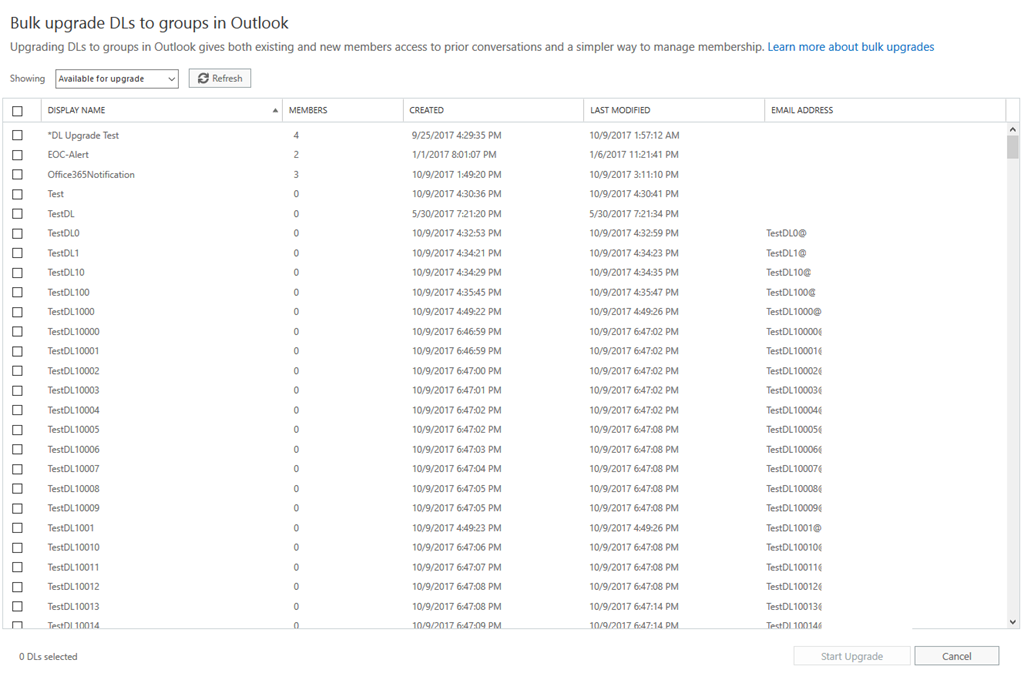
When the upgrade option is selected a new window is presented to select distribution groups for upgrade. 


image


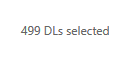
If we select all of the distribution lists for upgrade at once we can observe the number of upgrade operations that will occur in the lower left corner of the wizard.


image


In this instance only 499 distribution lists are selected but there are over 15,000 distribution lists that are eligible for upgrade.  Why does this occur?


In the Exchange Control Panel the upgrade wizard performs a discover of distribution lists that is limited at 10,000 distribution groups.  The service then performs eligibility checks against the 10,000 distribution lists that are selected and displays up to 499 eligible groups found within that group of 10,000.   It is possible that the picker could display less than 499 – for example if out of the 10,000 we found only 200 that were eligible the wizard would only display 200.  This means that there are distribution groups that could be eligible for upgrade that the picker will not display.


If the picker does not display the group for upgrade how does the group get upgraded?  The first step is to reference the links previously posted in this blog.  Administrators should execute the scripts attached to verify that the group has no upgrade blockers present.  If the group has no upgrade blockers present, and the group does not appear in the wizard for upgrade, Powershell must be utilized to perform the upgrade.  The commands are documented in the articles previously linked in this blog.  Here is an example:


Validate that the group exists as a universal group (legacy distribution list):


PS C:> $group=Get-DistributionGroup -Identity TestDL1001
PS C:> $group.GroupType
Universal


Queue the upgrade of the distribution list to an Office 365 group.


PS C:> Upgrade-DistributionGroup -DlIdentities $group.PrimarySmtpAddress

RunspaceId                      : 237b2e62-0770-4ba6-96f5-72a8dc6b5284
dlIdentity                      : TestDL1001@contoso.com
ErrorReason                     :
ExternalDirectoryObjectId       : dfa719d9-7507-4c7b-8e36-e07bad106975
SuccessfullySubmittedForUpgrade : True
Identity                        :
IsValid                         : True
ObjectState                     : Changed


When the group has been upgraded the get-distributionList command will no longer function.  The group is no longer a legacy group.


PS C:> $group=Get-DistributionGroup -Identity TestDL1001
The current operation is not supported on GroupMailbox.
    + CategoryInfo          : NotSpecified: (TestDL1001:String) [Get-DistributionGroup], RecipientTaskException
    + FullyQualifiedErrorId : [Server=BY1PR0601MB1402,RequestId=37473f52-d39a-4ef6-a3b5-ac8e2a744139,TimeStamp=10/10/2
   017 2:15:49 PM] [FailureCategory=Cmdlet-RecipientTaskException] 9034E99D,Microsoft.Exchange.Management.RecipientTa
  sks.GetDistributionGroup
    + PSComputerName        : ps.outlook.com


The properties of the group can now be viewed with get-UnifiedGroup:


PS C:> Get-UnifiedGroup TestDL1001

Name                      Alias                ServerName       AccessType
—-                      —–                ———-       ———-
TestDL1001_cc0807653c     TestDL1001           by1pr0601mb1402  Private


A legacy distribution group can also be updated using the new-UnifiedGroup command.  In this example we will create a distribution group with new-distributionGroup.


PS C:> New-DistributionGroup TestDL
New! Office 365 Groups are the next generation of distribution lists.
Groups give teams shared tools for collaborating using email, files, a calendar, and more.
You can start right away using the New-UnifiedGroup cmdlet.

Name   DisplayName GroupType PrimarySmtpAddress
—-   ———– ——— ——————
TestDL TestDL      Universal TestDL@domain.onmicrosoft.com

The upgrade can then be performed with the new-unifiedGroup command.


PS C:> $group=Get-DistributionGroup TestDL
PS C:> New-UnifiedGroup -DlIdentity $group.PrimarySmtpAddress

Name                      Alias                ServerName       AccessType
—-                      —–                ———-       ———-
TestDL_1521da9ce5         TestDL               by1pr0601mb1402  Private


This is the process that can be utilized to upgrade a legacy distribution list that does not appear in the upgrade wizard.

Office 365: Converting a remote mailbox to a mail user…

In Office 365 it may become necessary to change recipient types for on premises accounts.  In this scenario contoso.com provided a mailbox within their Office 365 tenant for a user.  A decision was made to host the users mailbox within a different mail system but authentication would still occur against the contoso.com domain.  The desire was to retain the original active directory account provisioned for the user and have the user appear in the global address list with routing information to the new mail system.


Let’s take a look at this example. 


In the contoso.com directory a user account was provisioned.


PS C:> Get-ADUser testcontoso | fl

DistinguishedName : CN=Test Contoso,OU=Users,OU=UsersOU,DC=contoso,DC=local
Enabled           : True
GivenName         : Test
Name              : Test Contoso
ObjectClass       : user
ObjectGUID        : a89d3274-747d-4f10-8fa6-68ea419656d1
SamAccountName    : TestContoso
SID               : S-1-5-21-2774288044-2073832935-89463056-1298
Surname           : Contoso
UserPrincipalName :
TestContoso@contoso.com


The user was enabled for a remote mailbox using the command enable-remotemailbox.  Once the object is replicated through directory synchronization a new remote mailbox will be created within Office 365.


[PS] C:>Enable-RemoteMailbox -Identity TestContoso -RemoteRoutingAddress testcontoso@contoso.mail.onmicrosoft.com

Name                 RecipientTypeDetails         RemoteRecipientType
—-                 ——————–         ——————-
Test Contoso         RemoteUserMailbox            ProvisionMailbox


We can verify the account creation in Azure Active Directory with get-msolUser.


PS D:> Get-MsolUser -UserPrincipalName testcontoso@contoso.com

UserPrincipalName              DisplayName  isLicensed
—————–              ———–  ———-
TestContoso@contoso.com        Test Contoso False


The final step in provisioning is verification of the Exchange Online Account.  This can be performed with get-recipient.


PS D:> Get-Recipient TestContoso

Name         RecipientType
—-         ————-
Test Contoso UserMailbox


When reviewing the object on premises there are active directory attributes that in conjunction with directory synchronization control how the object is created and provisioned in the service.  For this example we are particularly interested in an attribute msExchRemoteRecipientType.  For a remote mailbox that was provisioned using on premises commands enable-remoteMailbox the remote recipient type should be a value of 1. 


msExchRemoteRecipientType: 1;


In our example the value is 1.  A good reference for recipient display types https://blogs.technet.microsoft.com/johnbai/2013/09/11/o365-exchange-and-ad-how-msexchrecipientdisplaytype-and-msexchangerecipienttypedetails-relate-to-your-on-premises/.


1               

0x1         

ProvisionedMailbox (Cloud MBX)


Now that we have established how the user and mailbox were provisioned we can review the conversion process.  In our example we want to convert the user from a REMOTE MAILBOX to a MAIL USER.  (A mail user is an active directory account that is extended with an email address outside the organization for the purposes of allowing authentication to the directory, allowing the user to appear in the global address list, and having messages sent from the source mail system to the remote mail system.).


The process starts by disabling the remote mailbox.  This is accomplished utilizing the disable-remoteMailbox command.


[PS] C:>Disable-RemoteMailbox TestContoso -Confirm:$FALSE


This process removes the Exchange attributes from on premises and adjusts the remote recipient type.  In this case the remote recipient type is adjusted to 8. 


msExchRemoteRecipientType: 8;


8               

0x8            

DeprovisionMailbox

At this stage the user account still exists in on premises Active Directory and still exists in Azure Active Directory.  We have not deleted nor modified further the account. 


To enable the account as a mail user we will use the enable-mailUser command.


[PS] C:>Enable-MailUser TestContoso -ExternalEmailAddress test@contoso.com

Name                                     RecipientType
—-                                     ————-
Test Contoso                             MailUser


Using the get-recipient command we can validate the attribute set on premises – specifically the email addresses and target address.


[PS] C:>Get-Recipient TestContoso | Select-Object EmailAddresses,ExternalEmailAddress,PrimarySMTPAddress | fl

EmailAddresses       : {smtp:TestContoso@contoso.mail.onmicrosoft.com,
                       smtp:TestContoso@contoso.org, smtp:TestContoso@contoso.com,
                       SMTP:test@external.com}
ExternalEmailAddress : SMTP:test@external.com
PrimarySmtpAddress   : test@external.com


In the case of a mail enabled contact the primary SMTP address, external SMTP address, and primary email address in the proxy addresses signified by SMTP: should all match.  This is one of the few cases where a primary proxy address will reflect an external non-owned address.


We can verify the same information in Exchange Online using get-recipient.


PS D:> Get-Recipient TestContoso | Select-Object RecipientType,EmailAddresses,ExternalEmailAddress,PrimarySMTPAddress | fl

RecipientType        : MailUser
EmailAddresses       : {X500:/o=contoso/ou=Exchange Administrative Group (FYDIBOHF23SPDLT)/cn=Recipients/cn=84d0cea822fe44509f4382fdaed37ab5-Test Co, SMTP:TestContoso@contoso.onmicrosoft.com,
                       smtp:TestContoso@contoso.mail.onmicrosoft.com, smtp:TestContoso@contoso.com, smtp:TestContoso@contoso.org}
ExternalEmailAddress : SMTP:test@external.com
PrimarySmtpAddress   : TestContoso@contoso.onmicrosoft.com


This output confirms that a mail user object has been provisioned in the service but the addresses do not match on premises?  Why?


In this instance the provisioning process is confused by the presence of the remote recipient type on premises.  A typical mail user does not have a remote recipient type set.   In this instance the mail user will work, but any attempts to search via SMTP address or information displayed on contact cards may not be consistent with expectations.  For example, the contact in the on premises GAL would show a primary proxy of the external address while the Exchange Online GAL would show a primary proxy of the internal address.  Although this display is not the same – we will route messages correctly to the external recipient since the external email address is properly set.


How do we fix this issue?


In order to correct this condition the remote recipient type needs to be cleared.  Using Active Directory Users and Computers ensure advanced features is enabled (view –> advanced features).  Locate the user account on premises and select properties. 


image


Select the EDIT button –> CLEAR –> OK.  This will revert the entry to NOT SET.  The apply button will commit the change to the directory.  Directory replication and directory synchronization will apply the change to Azure Active Directory and Exchange Online.


image


When changes have replicated successfully we can use get-recipient to validate the changes in Exchange Online.  The primary proxy address listed in SMTP addresses and signified with SMTP: matches the primarysmtpaddress field.  The fix was successful.


PS D:> Get-Recipient TestContoso | Select-Object RecipientType,EmailAddresses,ExternalEmailAddress,PrimarySMTPAddress | fl

RecipientType        : MailUser
EmailAddresses       : {smtp:TestContoso@contoso.onmicrosoft.com, SMTP:test@external.com, X500:/o=contoso/ou=Exchange Administrative Group
                       (FYDIBOHF23SPDLT)/cn=Recipients/cn=84d0cea822fe44509f4382fdaed37ab5-Test Co, smtp:TestContoso@contoso.mail.onmicrosoft.com, smtp:TestContoso@contoso.com,
                       smtp:TestContoso@contoso.org}
ExternalEmailAddress : SMTP:test@external.com
PrimarySmtpAddress   : test@external.com


This is the process that can be utilized to convert a remote mailbox to a mail user.